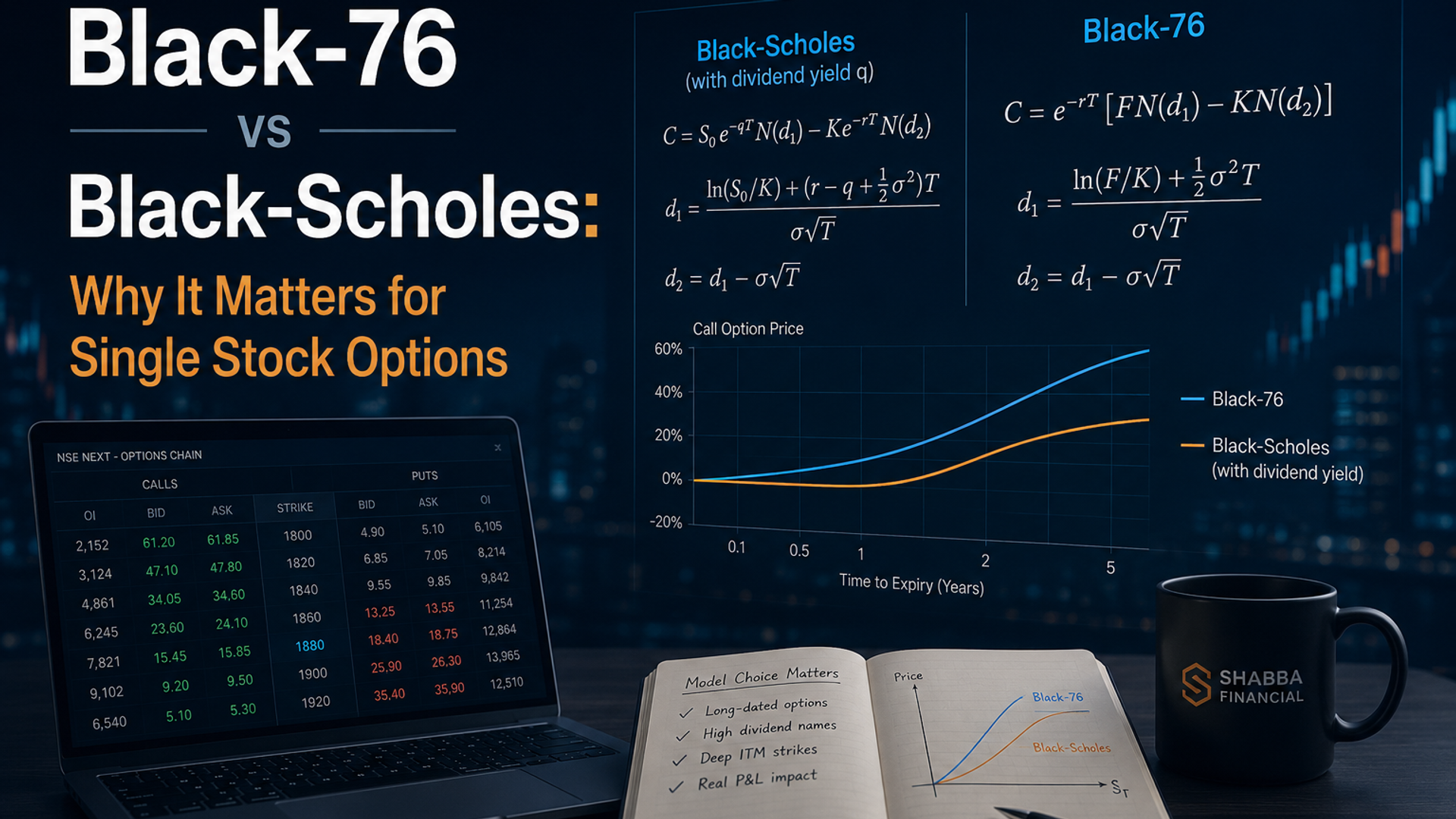
Most working quants learn Black-Scholes first and never have a reason to look at Black-76. The two formulas produce closely related numbers under most conditions. Quote screens display the price, not the model that produced it. As long as the option chain looks sane and the Greeks roll up cleanly, it is easy to assume that the difference between the two pricing frameworks is academic. It is not. The difference matters precisely in the cases where options market makers most often lose money: long-dated contracts, high-dividend underlyings, and deep in-the-money strikes.
For options on Single Stock Futures, the correct framework is Black-76. Not because Black-Scholes adapted with a dividend yield approximates the right answer most of the time. It does. The reason to use Black-76 is that the cases where Black-Scholes adapted does not approximate are the cases where the option is doing real work: hedging an actual exposure, expressing a serious view on volatility, sized large enough that the mispricing compounds into a meaningful P&L impact. This post walks through what the two models actually compute, where they diverge, and why an algorithmic options market maker on NSE NEXT needs to use Black-76 directly.
What Black-Scholes actually prices
Black-Scholes (1973) prices a European call or put on a spot asset that pays no dividends. The setup is geometric Brownian motion for the spot price, a constant risk-free rate, no transaction costs, and continuous trading. The output is the no-arbitrage premium of the option as a function of spot price, strike, time to expiry, volatility, and the risk-free rate.
The Merton extension, also from 1973, generalizes the model to handle a continuous dividend yield. This is the version every practitioner actually uses for equity options. The dividend yield enters as a downward adjustment to the spot drift, because dividends paid before expiry reduce the expected terminal price. The pricing formula becomes a function of six inputs rather than five: spot, strike, time, volatility, risk-free rate, and dividend yield.
The dividend yield is where almost all of the practical complications begin. Continuous-yield is a modelling convenience; real dividends are discrete events on known ex-dates. For most equities the continuous-yield approximation is good enough. For long-dated options on high-dividend names, it stops being good enough, and the practitioner has to either use a discrete-dividend model or accept systematic mispricing on certain strikes.
What Black-76 actually prices
Black-76 prices a European call or put on a forward or futures contract, not on the spot. The price input is the forward price F, not the spot price S. The cost-of-carry term disappears from the drift in the risk-neutral measure because for a futures contract the risk-neutral expectation of the future terminal price equals the current futures price by construction. This is the cleanest property of the model: the messy machinery of carry, dividends, and funding cost has already been done by the futures market that generated F.
The pricing formula for a call under Black-76 is a discount factor times the difference between F times the cumulative normal of d1 and K times the cumulative normal of d2, with d1 and d2 defined as in Black-Scholes but with the drift term reduced to the variance-half-life-only piece. In plain language: you replace S with F, you drop the cost-of-carry term inside d1 and d2, and you keep the same discount factor on the payoff. Everything else is identical to Black-Scholes.
The mathematical bridge
Black-76 and Black-Scholes (with continuous dividend yield) are mathematically equivalent under the substitution F equals S times the exponential of the cost-of-carry minus dividend yield times time. In other words, if you correctly compute the implied forward price from spot, rates, and dividends, plug it into Black-76, you will get the same answer Black-Scholes would have given you with the right q.
This equivalence is the source of the common shortcut, which is to use Black-Scholes with an implied dividend yield retrofitted to match observed futures prices. The shortcut works arithmetically. It hides three problems that matter operationally. First, the implied yield you back out is not the actual dividend yield. It is the cost-of-carry minus the funding rate of the futures market, which is not the same thing. Second, the implied yield drifts over time as the futures basis moves for reasons unrelated to dividends. Third, when you compute Greeks, the rho of your position is now wrong because your model thinks it has both an r and a q exposure when it really only has an r exposure (the one inside the discount factor).
| Property | Black-Scholes (with q) | Black-76 |
|---|---|---|
| Price input | Spot S | Forward / futures F |
| Drift term in d1 | (r - q + sigma^2 / 2) T | (sigma^2 / 2) T |
| Discount factor | e^(-rT) on K only | e^(-rT) on the whole payoff |
| Carry assumption | Embedded via q | Already in F |
| Risk-free rate exposures | rho on r, q-rho on q | One rho on r only |
| Natural use case | Options on a spot asset | Options on a futures contract |
Pricing models are not interchangeable just because they produce similar numbers. The differences live in the second decimal place, which is where market-makers compete.
Why the BS-with-q shortcut breaks on SSF options
When the underlying is a Single Stock Future, the shortcut breaks in a specific way. The futures price F is not a derived quantity that you can compute from spot, rate, and dividend yield. It is a market price determined by supply and demand on the futures venue, which on NSE NEXT today is a young and not-fully-deep market. The basis between spot and futures is a function of carry, funding, expected dividends, and the residual imbalance of buyers and sellers in the futures book itself. Treating that observed basis as if it were a clean q for plugging into Black-Scholes contaminates the model with futures-market noise that has nothing to do with the option being priced.
Black-76 sidesteps this. The model takes F as a direct observable. Whatever the futures market thinks the right F is, that is the input. No inference about dividend yield, funding cost, or basis is required. The pricing of the option separates cleanly from the pricing of the underlying. This is the right architecture for a market maker who is also hedging through the futures, because the hedge instrument and the option instrument now share a consistent pricing axis.
Where mispricing shows up
The places where Black-Scholes-with-q and Black-76 diverge are the places that decide whether an options book is profitable. Four cases stand out, and a competent options market maker has views on all four before quoting.
Long-dated options
The longer the time to expiry, the more the assumed continuous dividend yield diverges from the actual discrete dividend stream. Mispricing compounds with maturity. Black-76 with the observed F eliminates this source of error.
Deep in-the-money strikes
The intrinsic value of a deep ITM option is dominated by the underlying price input. If you are using S plus an imputed q rather than F directly, you are pricing the intrinsic component through a noisy proxy. Black-76 prices it through the actual market.
High-yield underlyings
Banks and telcos dominate the NSE 20 and pay material dividends. The continuous-yield approximation is least accurate exactly where these names sit, particularly across ex-dividend dates. Using F directly skips the approximation.
Rate-sensitive structures
Any structure with multiple legs at different rate sensitivities, common in institutional hedging packages, accumulates rho exposure that BS-with-q misattributes between r and q. Black-76 collapses this to a single rho on r, which is what the position actually has.
Implementing Black-76 correctly
The actual implementation is short. Compute d1 and d2 with F instead of S and with no carry adjustment. Apply the cumulative normal. Multiply by e to the minus rT to discount the payoff. Hedge with the corresponding SSF. Track delta against F, not S. Track rho against r only. The implementation is so concise that the discipline is in the inputs, not the formula.
Three discipline items separate a working Black-76 implementation from a broken one. First, the F input must come from the actual SSF mid-price, not a synthetic forward computed from spot and rates. The whole point of using F directly is to inherit the futures-market pricing, including its noise. Second, the discount rate r must be a clean short-rate appropriate for the option maturity, not a spread-adjusted funding rate that bakes in unrelated credit assumptions. Third, the vol surface is parameterized in moneyness defined against F, not against S. SVI calibration is done in (K / F) space, not (K / S) space. This makes the surface invariant to changes in the spot-futures basis.
Once those three inputs are right, everything else follows. The Greeks roll up correctly. The hedging engine takes care of delta exposure via the SSF leg. Vega, gamma, and theta exposures are tracked against the same surface in the same coordinates. The position is internally consistent in a way it cannot be under the Black-Scholes-with-q shortcut.
Where Shabba sits
Black-76 with observed F, SVI in moneyness against F
Our OSF pricing on NSE NEXT is Black-76 with the F input taken directly from the SSF mid-price. The vol surface is parameterized in moneyness defined against F. The hedge instrument and the pricing instrument share a coordinate system. This is the architecture an options market maker needs to operate inside a young futures market without inheriting that market's pricing noise into the option chain.
A practical aside on testing
A useful exercise for any quant working on SSF options pricing for the first time: take a real F from the SSF book, build the Black-76 price for an at-the-money one-month call, then construct the equivalent Black-Scholes-with-q price by backing out q from F and spot. The numbers will be close. Now do the same exercise for a one-year call and a deep ITM strike. The numbers will visibly diverge. Now do it across a known ex-dividend date. The numbers will diverge sharply. This is the entire argument compressed into a thirty-minute notebook session.
The choice between Black-76 and Black-Scholes-with-q is not stylistic. It is a choice about which market noise enters your option pricing model. For options on Single Stock Futures, the right choice is the model that takes F as it is and prices the option around it.